
Unlock Predictable Delivery with Short Term Planning
Monday starts with three Slack pings, two client “quick changes,” a designer waiting on copy, and a developer asking which Figma file is final. By noon, the week already feels lost.
That is the normal failure mode in agency delivery. Not laziness. Not a bad team. Just too many moving parts, spread across too many clients, with too much work living in inboxes, chat threads, meeting notes, and people’s heads.
Short term planning fixes that when it stays lightweight. It gives the team a near-term horizon they can manage. It turns vague urgency into a visible list of commitments. It also keeps the work adaptable when clients change direction midstream, which they will.
For agencies, this is not just an operations habit. It is a performance lever. Organizations that balance long-term and short-term planning achieve 47% higher revenue growth and 36% higher profitability, according to McKinsey research cited here. That tracks with how agency work runs. The annual plan matters, but weekly execution decides whether work ships, clients stay calm, and margins hold.
Table of Contents
- From Yearly Goals to Weekly Wins
- Choosing Your Agency’s Planning Cadence
- How to Structure Your Short-Term Plan in Orsane
- Rituals That Drive Alignment and Progress
- Prioritizing Work and Measuring What Matters
- Common Short-Term Planning Pitfalls to Avoid
- Start Your First Planning Cycle This Week
From Yearly Goals to Weekly Wins
Annual planning feels responsible. It looks organized in a deck. It also falls apart fast in a creative agency, because client requests do not arrive neatly on quarterly timelines.

A web studio might set a clean roadmap in January, then spend February handling revision loops, emergency launches, and missing assets. A content team can plan a full month, then lose two days to client approvals. The problem is not planning itself. The problem is planning at the wrong altitude.
Why long-range plans alone fail
Long-range goals are still useful. They set direction, staffing assumptions, and revenue targets. But they are too blunt for daily delivery.
Agencies need a system that answers practical questions fast:
- What ships this week
- What is blocked right now
- Who owns the next step
- What can wait without hurting the client or the team
Without that layer, people invent their own priorities. Account managers promise dates before checking capacity. Creatives juggle five half-started tasks. Developers inherit incomplete handoffs and lose time clarifying basics.
What short cycles do better
Short term planning narrows the field. It gives the team a realistic slice of work and forces trade-offs into the open. That alone reduces a lot of background stress.
It also creates a healthier relationship between strategy and execution. The yearly plan says where the agency is going. The weekly plan decides what gets finished next. When those two horizons work together, leadership gets visibility and teams get room to adapt.
A short-term plan should feel like a working agreement, not a ceremony. If the team cannot explain the week in a few minutes, the plan is too heavy.
The biggest shift is mental. Planning stops being a document you create for management and becomes a shared tool for reducing confusion. In agency life, that is the difference between constant fire drills and predictable delivery.
Choosing Your Agency’s Planning Cadence
The first decision is simple on paper and surprisingly important in practice. Will you plan weekly or every two weeks?
There is no universal right answer. The best cadence depends on how often work changes, how quickly clients respond, and how much coordination the team needs between disciplines.
Weekly works best when change is constant
A weekly cycle suits agencies with frequent feedback and mixed work types. That usually includes retainers, design production, website support, campaign work, and multi-client delivery where priorities can shift every few days.
Short-term planning is valuable partly because it supports a rapid response to economic fluctuations and market disruptions and relies on current data and analytics for better decisions, as noted in this discussion of short-term planning and budgeting. In agency terms, that means a weekly cycle gives you more chances to correct course before a small issue becomes a missed deadline.
Weekly planning tends to work well when:
- Clients are active: They review, revise, and redirect often.
- The team shares people across accounts: Capacity changes quickly.
- Handoffs happen constantly: Designers, writers, strategists, and developers depend on one another.
Bi-weekly helps when work needs longer focus
Bi-weekly cycles can work for product design, fixed-scope builds, deeper development work, or brand projects where context switching does more damage than delay.
That extra runway helps when the work needs sustained concentration. A developer building a feature or a designer working through a full system benefits from fewer planning interruptions. But there is a catch. A two-week cycle magnifies bad assumptions. If the plan is wrong on day one, you live with the consequences longer.
A simple comparison helps:
| Cadence | Best for | Main advantage | Main risk |
|---|---|---|---|
| Weekly | Retainers, support, fast-moving client work | Faster reprioritization | More planning touchpoints |
| Bi-weekly | Fixed-scope builds, focused production | More uninterrupted execution | Slower recovery when priorities shift |
Use these decision rules
If you are unsure, start weekly and earn your way to bi-weekly.
Choose weekly if client feedback regularly changes the order of work, if your team serves many accounts, or if handoffs are a recurring source of friction.
Choose bi-weekly only if your intake is stable, your scope is clearer, and the team can protect focused work without constant interruption.
If the team ends most weeks saying “half of this changed by Wednesday,” you do not need a longer cycle. You need a shorter one.
How to Structure Your Short-Term Plan in Orsane
The system needs to be simple enough that people will use it. That means clear lists, a small set of statuses, and task details that support handoffs instead of creating admin work.
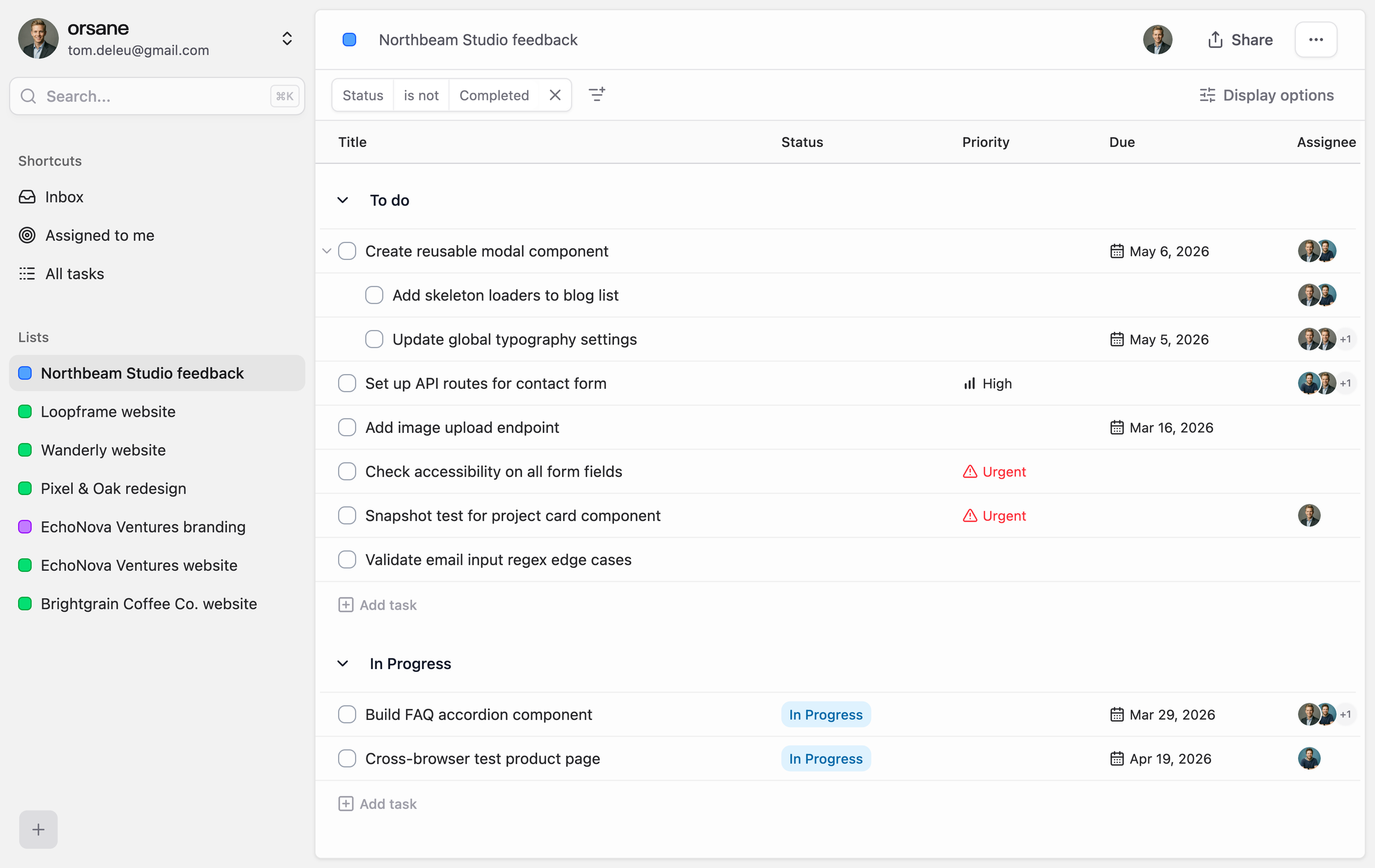
Build one list per delivery stream
Most agencies get into trouble when they create too many delivery streams too early. Work becomes scattered again, just inside a project tool this time.
Start with one master list for each delivery stream. That could mean one for web projects, one for retainers, or one for each major client group. Inside that list, keep the workflow visible with a small number of statuses:
- Client Backlog for approved work that is not scheduled yet
- This Cycle for work committed to the current week or two-week window
- In Progress for active work
- In Review for internal QA or client review
- Done for completed items
That is enough structure for most agencies. Resist the urge to add statuses for every nuance. “Waiting for assets,” “needs copy,” and “client silent” can live in task comments or attributes. The board should show flow, not every emotional state of the project.
Ownership matters too. One person should own backlog hygiene. Usually that is the PM, account lead, or delivery lead. Individual contributors should own moving their work once it changes status. If only the PM updates the board, the board becomes fiction by Wednesday.
Use tasks and subtasks to match real agency work
A good task is a deliverable or decision point, not a vague area of activity.
Bad task: homepage Better task: finalize homepage wireframe for client review Best task: finalize homepage wireframe, confirm mobile layout, attach review link, assign client review owner
Subtasks are where agency work gets cleaner. They let you break a deliverable into the handoff points that usually go missing:
- Design task: complete desktop layout
- Subtask: prepare mobile variant
- Subtask: add notes for developer
- Subtask: attach approved assets
- Subtask: request internal review
That structure helps because creative work rarely fails at the big-task level. It fails in the gaps between disciplines.
Keep the setup lightweight
Use a few custom fields only if they help decisions. In most agencies, these are enough:
- Priority
- Effort
- Client
- Owner
- Due this cycle or later
Do not build a mini enterprise system. If the team needs training just to create a task, the setup is already too heavy.
The cleanest agency boards answer three things at a glance: what is committed, what is blocked, and what is waiting on review.
Rituals That Drive Alignment and Progress
A board without habits turns stale fast. The useful part of short term planning is not the board itself. It is the rhythm around it.

Teams do not need a pile of ceremonies. They need a few recurring conversations that keep commitments realistic and handoffs clean.
Monday planning that does not eat the day
A good Monday planning meeting is short, specific, and mildly uncomfortable. It should force decisions about capacity. It should not become a status recital.
The flow is straightforward:
- Review last cycle briefly: What shipped, what slipped, and why.
- Pull work into the new cycle: Only add items the team believes it can complete.
- Call out dependencies: Missing assets, client approvals, unresolved copy, unclear scope.
- Trim aggressively: If capacity looks tight, remove work before the week starts.
That “trim aggressively” piece matters. Agencies often overplan because every client request feels politically important. Then the team spends the week carrying too much work in progress and finishing too little.
A planning meeting works better when the PM comes in with a proposed shortlist, not a blank board. The team then challenges that list based on capacity and known blockers.
Daily huddles and clean handoffs
Daily stand-ups should be fast. If they become a forum for problem solving, they drag. Keep them focused on movement.
A useful daily huddle sounds like this:
- What moved yesterday
- What should move today
- What is blocked and who needs to help
That is enough. Deep discussion can happen after with the people involved.
The other ritual that matters in agencies is the handoff. Design to dev. Copy to design. Strategy to production. That is where “almost done” becomes delayed.
Poor file versioning and handoff processes contribute to delays in 48% of creative agencies, according to a 2025 Clutch Agency Survey cited here. Anyone who has chased the “latest-final-v3-actual-final” file knows why.
A proper handoff includes more than attaching a file. It should include:
- The approved asset: Not a draft buried in a folder.
- Context: What changed and what is fixed versus flexible.
- Acceptance details: What the next person needs to deliver.
- Owner transfer: Who now has the ball.
Here is the difference in real life. A designer marks a task “done” after finishing screens. The developer opens it and finds no notes, no source link, and no answer on whether mobile is approved. The task moves backward. Momentum dies.
The better version is boring in the best way. The task includes the approved file, a short implementation note, and a clear owner change. No scavenger hunt. No guesswork.
Handoffs fail when teams assume proximity equals clarity. It does not. The task needs to carry the context.
Prioritizing Work and Measuring What Matters
Most agency planning failures are not caused by laziness. They start with bad selection. Too much goes into the cycle, low-value work sneaks in, and the team loses focus.
A simple way to choose what makes the cut
Use an impact-versus-effort lens before work enters the cycle. It does not need to be formal. It just needs to be honest.
A PM can sort proposed work like this:
- High impact, low effort goes in first
- High impact, high effort needs deliberate capacity protection
- Low impact, low effort fits only if it unblocks something else
- Low impact, high effort usually stays out
This helps agencies avoid a common trap. Small client asks often feel urgent because they arrive loudly, not because they matter most. The team then burns capacity on visible noise while high-value deliverables slip.
Custom attributes help here. Tag tasks with priority, effort, and client. The board becomes easier to scan, and trade-offs get less emotional because the criteria are visible.
Metrics that improve delivery instead of creating noise
You do not need a dashboard stuffed with vanity metrics. A few delivery signals are enough.
One of the most useful is Percentage Plan Complete, or PPC. In the Last Planner System, weekly planning aims for PPC of over 70 to 80%, and studies show on-time delivery can improve from 50 to 60% to over 85%, according to this overview of LPS planning methods. For agencies, PPC is a blunt but helpful question: of the work you committed to this cycle, how much got done?
The other metric worth watching is cycle time. Not as a vanity number. As a way to spot drag. If “design homepage review” sits too long every cycle, there is probably a review bottleneck, an approval issue, or a handoff problem hiding underneath.
A practical scorecard looks like this:
| Metric | What it tells you |
|---|---|
| PPC | Whether commitments are realistic |
| Cycle time | Where work slows down |
| Tasks stuck in review | Whether approvals are the primary bottleneck |
The point is not to measure more. It is to learn where your planning keeps breaking.
Common Short-Term Planning Pitfalls to Avoid
Short term planning works. It also breaks in predictable ways. Most of the damage comes from trying to be accommodating and ending up overloaded.
The plan breaks when everything is urgent
The first trap is overcommitment. Teams pack the cycle with too much work because nobody wants to disappoint a client or internal stakeholder. By midweek, the board is crowded, people are multitasking, and nothing cleanly finishes.
The second trap is scope creep. In Agile sprints, scope creep can inflate sprint workload by 25 to 35%, according to this sprint planning reference. Agencies feel that quickly because client work changes in small increments. One extra page. One more round. One tiny revision that drags in design, copy, and dev.
The fix is not to become rigid. It is to create a rule. New work entering the cycle should force a visible trade-off. If something important gets added, something else gets removed or rescheduled. Otherwise the plan stops meaning anything.
When the team keeps missing the week
Another common issue is ignoring historical output. Teams plan based on optimism instead of what they finish. The result is predictable disappointment.
The same sprint planning reference notes that ignoring historical velocity can lead to a 50% miss rate on commitments. The agency version of this is easy to recognize. Every planning meeting sounds ambitious, every Friday feels apologetic, and nobody trusts the estimates anymore.
If that is happening, do not respond by adding more process. Shrink the commitment size.
Try these corrections:
- Commit to fewer items: Finish more, carry less.
- Break work down further: Large tasks hide uncertainty.
- Separate planned work from interrupts: Do not pretend urgent support work does not exist.
- Track reasons for misses: Approval delay, hidden dependency, poor scoping, unclear ownership.
A final trap is turning planning into bureaucracy. When the meeting becomes longer than the work discussion it supports, people disengage. Creative teams do not reject planning because they hate structure. They reject planning that feels detached from the work.
If the system takes more energy to maintain than the clarity it creates, simplify it.
Start Your First Planning Cycle This Week
The best version of short term planning is not complicated. It is visible, honest, and easy to maintain when client work gets messy.
A lightweight system gives the team three things quickly. Better clarity on what matters now. Better predictability on what will ship. Less stress from chasing updates across five tools and ten conversations.
Start small. Do not redesign your entire operating model.
A practical first step
Use this simple checklist:
- Set up a couple of lists with a backlog, current cycle, active work, review, and done.
- Schedule one planning meeting and keep it tight. The goal is a realistic commitment, not a performance.
- Commit to three key tasks for the first cycle. Finish them cleanly, then expand.
That is enough to prove the value. Once the team trusts the rhythm, you can refine task size, improve handoffs, and tighten prioritization. But the first win is getting everyone to look at the same reality.
Short term planning should reduce overhead, not create a new layer of admin. When it is done well, people stop asking where things stand and start moving work forward with less friction.
If your agency is tired of bloated PM tools and wants a cleaner way to run short term planning, Orsane is worth a look. It is built for multi-client delivery, creative handoffs, and cross-discipline work without the enterprise clutter. The grid-based setup is easy to adopt, and the 14-day free trial makes it easy to test your first planning cycle without a heavy rollout.